
Encrypted by David Mboussou, Cultural Curator. Inspired by Ancestral Intelligence, combined with Articial Intelligence.
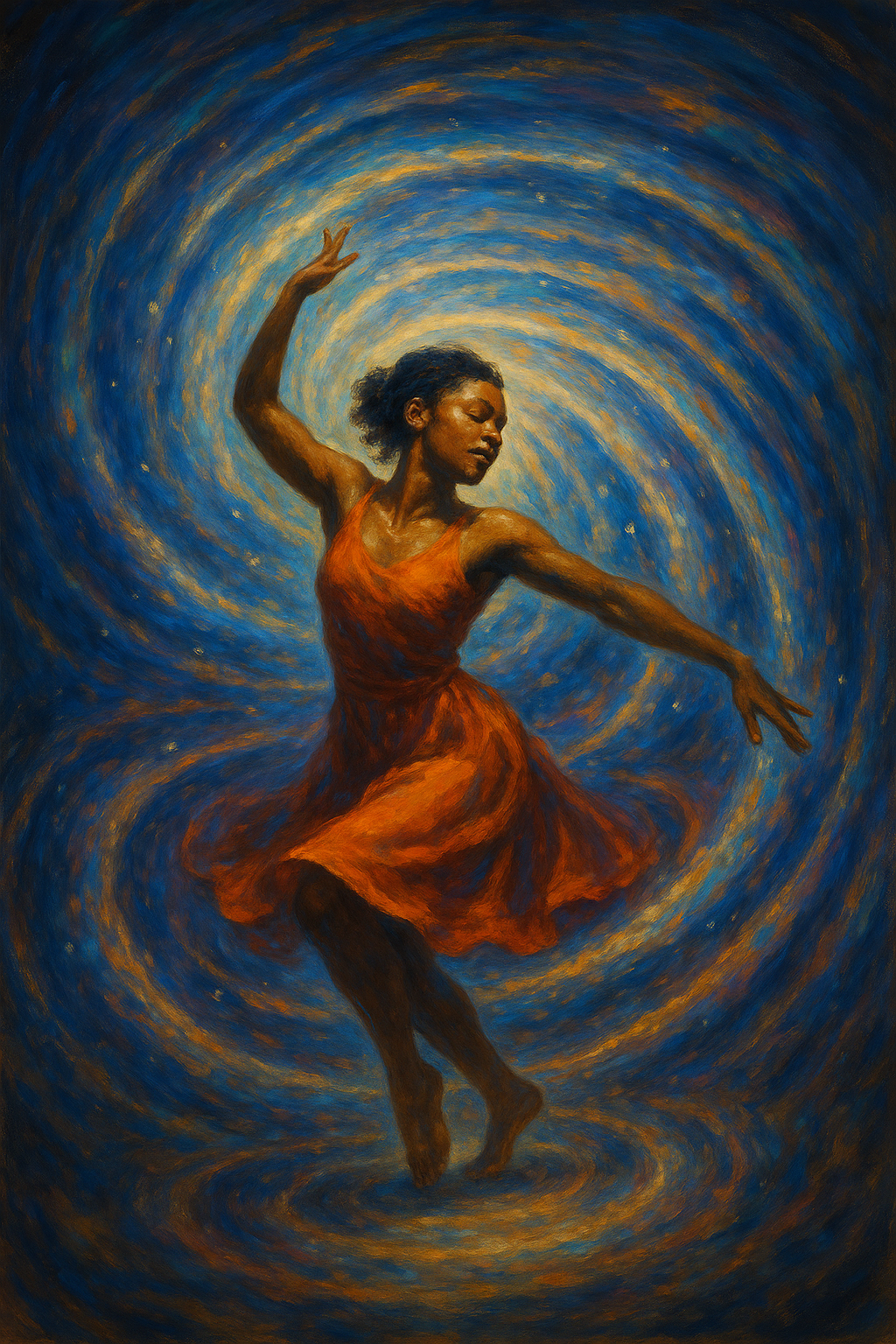
In every culture, ritual responds to a human paradox: we rarely feel the same things at the same time, yet we long to share moments of communion. African traditions developed collective forms of presence—songs, dances, offerings, initiations—that are far more than folklore. They create a sacred space-time where individuals attune themselves to each other and to the cosmos.
What imported languages once labeled “animism” is in fact a cosmology of continuum: the living, the ancestors, and the sacred are woven together. Memory is not stored only in texts but in bodies, gestures, music, and rhythm. To mock Black morphology, stigmatize its physical expressions, or demonize its rituals is not neutral: it severs a people from its living archives.
The labeling of African “liturgy” as “witchcraft” served as a moral justification for colonization and forced conversion. It obscured the universal nature of good and evil, as if they belonged to one continent alone. This demonization produced deep traumas, a rejection of self and of one’s own embodied codes, and a rupture with ancestral memory.
Yet Afro memory has survived multiple systemic traumas—slavery, deportation, colonization, segregation. It has recomposed itself in new contexts across the Americas, Europe, and beyond, producing jazz, gospel, capoeira, hip-hop, krump, Haitian vodou, Brazilian candomblé, and more. This capacity for reinvention shows the universal vocation of Afro-Diasporic culture. It is not a mere folklore; it cohabits with every culture and pigment; it mixes without disappearing.
To read the Afro-Diasporic world only through the prism of “black/white” opposition limits its scope. Current struggles are less about racial assignment than about the refusal to be held as an object or subject of fear, and about the demand for mutual respect. This has geopolitical consequences: Afro-Diasporic cultures today form a transnational network of imaginaries, practices, and values capable of influencing the creative economy, cultural industries, cultural diplomacy, and even global governance.
The new Afro-Diasporic generation does not only seek a “return to the motherland.” It carries a project of realignment: personal realignment through self-recognition and respect for one’s body and memory; collective realignment through renewed communions and reinvented rituals; and universal realignment through love of one’s neighbor as oneself, in relation to the infinite Whole.
By reconnecting with the sacred and communal dimension of traditions—not to turn them into an instrument of control but to recover their divine source—this generation can transform trauma into creative power and contribute to a civilization of respect and resonance.

 DAVID MBOUSSOU